Observer Points Model
Observer Points Model
“THERE” — a gesture of pointing at something ahead. For this gesture to take place, there must be a distance between the one who points and what is being pointed at. But one can point with closed eyes, at something that cannot be seen, even without having anything with which to point. In the Observer Points Model, the gaze is freed from the physiological limitations of vision. The Model itself can be understood as an extended explanation of this gesture of pointing.
The Observer Points Model was created by a single observer for himself and describes what and how he observes. Its subject is not the observer but the process of observation. In the Model, an act of observation consists of discovering and fixing a single point among a multitude of points on an arbitrarily chosen plane of what is presented to the observer. Without such discovery and fixation, no act of observation takes place.
The world, in the process of being observed, is only formed through that very process. There is no certainty that it would exist, or exist in the same way, if it had not entered the field of observation. At the same time, each particular act of observation determines the temporary position of the observer himself — “here-observation”. The gaze that pins the world in place inevitably becomes pinned to it in turn. This mutual binding lasts exactly as long as the particular act of observation, while the observer himself remains a stable source of such acts.
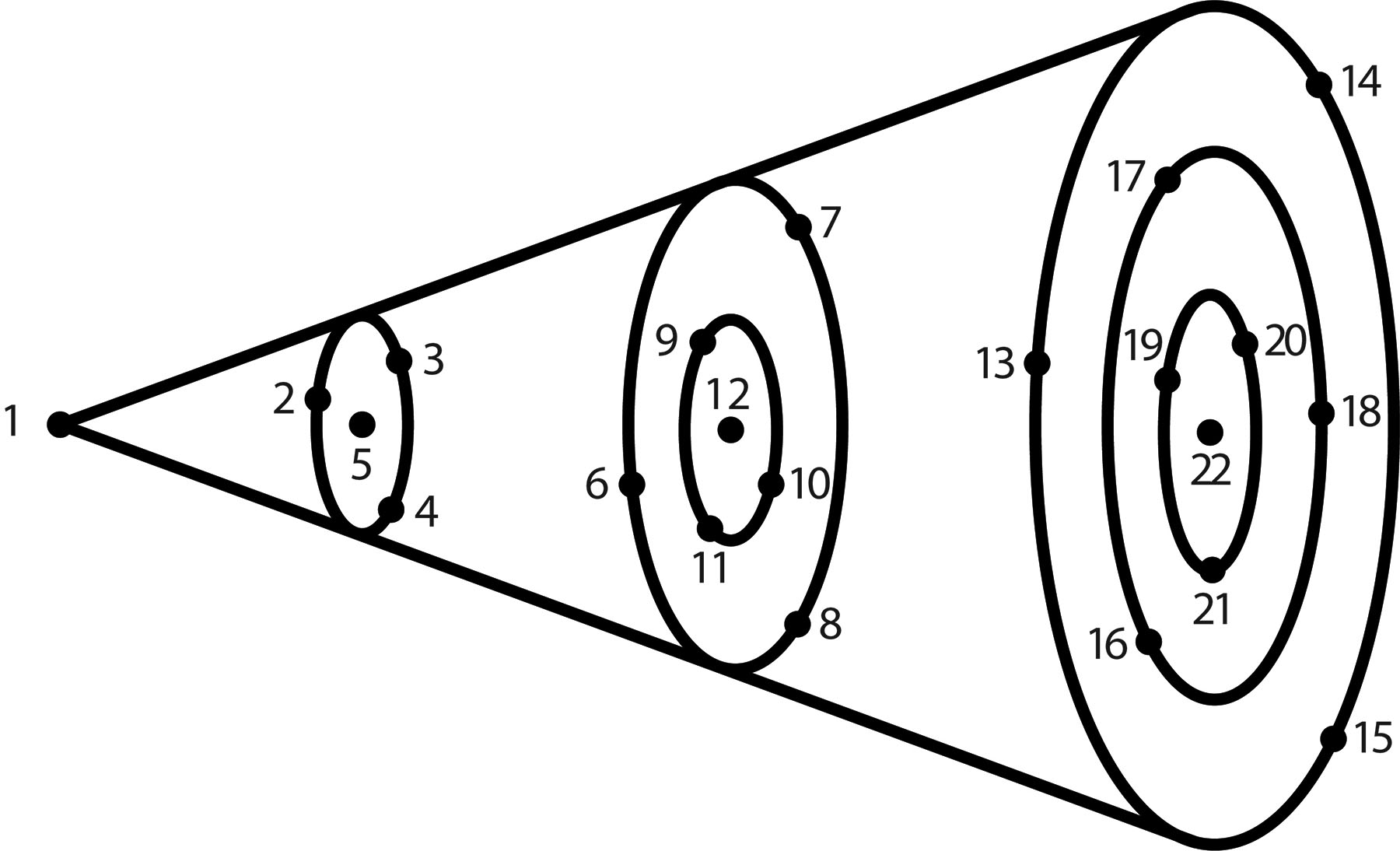
In each act of observation, a single point is discovered, yet the number of points in the world tends towards infinity. The Model, however, has a single point of reference — Point 1, where the observer's gaze presumably first discovers itself. To avoid counting points endlessly, another 21 are added to the first. The number 22 is accepted as an axiom: it creates the conditions for the existence of the Model without setting a limit on what can be discovered in the process of observation.
Graphically, the Model takes the form of a cone of attention. Point 1 is located at its apex, while its base coincides with the limits of the entire observable world. The angle of the cone depends on the observer's experience. The cone contains four circles of attention — the inner, small, medium, and large circles. From the inner space with closed eyes, through one's own body and the present situation, to everything accessible to the observer's gaze, as well as what lies beyond its reach but, through imagination, becomes part of the observed world.
At the centre of the cone's base lies Point 22 — the ultimate point of the gaze, whose distance from Point 1 tends towards infinity. It is not a finish line, but the last number assigned to a point beyond which the observer's gaze can discover nothing. Yet the ultimate task of observation remains the discovery of the observer himself — the possibility of meeting his own gaze. Theoretically, the coincidence of Points 1 and 22 would allow the observer to take his place within the overall picture of the world — to meet his own gaze. Then “THERE” would disappear, leaving only “HERE”.